A pneumatic cement ship unloader operates based on the core principles of pneumatic conveying systems, using airflow and pressure differentials to transfer bulk cement from ship holds to onshore receiving points. Instead of mechanical handling, cement is extracted, transported, and discharged through a fully enclosed air-driven process. Understanding the working principle of a pneumatic cement ship unloader provides essential insight into how fine powder materials are efficiently moved through pipelines using controlled airflow and pressure regulation.
Pneumatic Cement Ship Unloader Working Principle Based on Pneumatic Conveying Fundamentals
The working principle of a
pneumatic cement ship unloader is fundamentally rooted in the operating laws of pneumatic conveying systems, where bulk cement is transported using airflow as the primary driving medium. Unlike mechanical unloading methods that rely on physical contact or moving parts to lift material, pneumatic systems use pressure differentials to mobilize fine particles. Cement, due to its powdery nature and relatively uniform particle size, behaves predictably when subjected to controlled airflow. This makes pneumatic conveying cement an effective and technically coherent solution for ship unloading operations. The entire unloading process is governed by the interaction between air velocity, pressure gradients, and material properties, which together define how cement is extracted, transported, and discharged within a closed system.
=>See more: Why ports need a cement ship unloader for efficiency
Pneumatic Cement Ship Unloader Working Principle at the Cement Pickup Stage
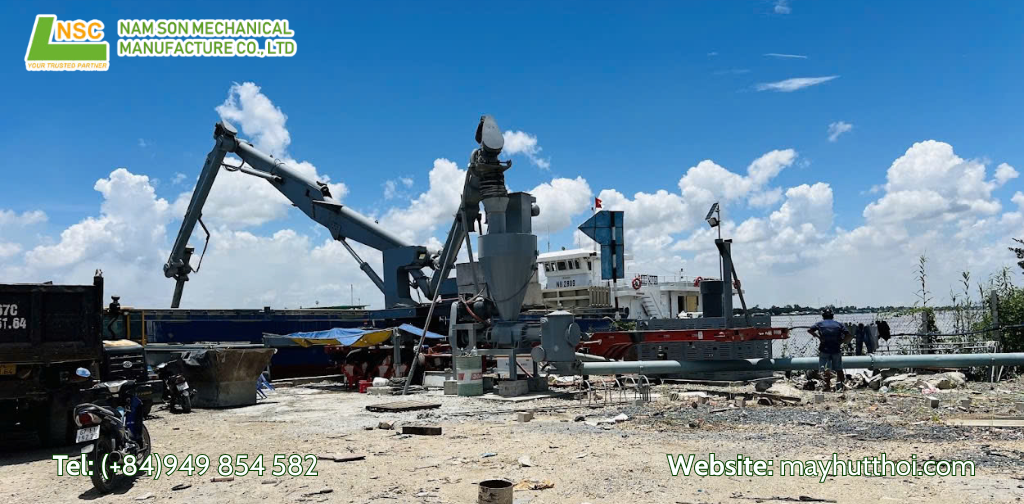
The initial stage of the pneumatic cement ship unloader working principle occurs at the cement pickup point inside the ship hold. At this location, a suction intake device, commonly referred to as a pneumatic suction nozzle for cement, is positioned in direct contact with the bulk material. A localized pressure reduction is generated at the nozzle through the action of fans or vacuum units, creating a pressure gradient between the surrounding atmosphere and the interior of the conveying line. Cement particles naturally move toward the region of lower pressure, becoming entrained in the incoming airflow. At this moment, cement transitions from a static bulk state into a mobile phase governed by fluid–particle dynamics. This pickup mechanism is critical because it establishes the initial stability of the conveying process and determines how uniformly material enters the pneumatic system.
Pneumatic Cement Ship Unloader Working Principle in Air–Cement Mixing
Once cement is drawn into the intake zone, it immediately mixes with the conveying air to form an air–solid suspension. Within air conveying cement unloading systems, this mixing stage is essential for maintaining continuous flow. The airflow must reach a minimum velocity sufficient to overcome gravitational forces acting on individual cement particles. If this condition is met, cement remains suspended within the stream and behaves as part of a multiphase flow. The ratio between air volume and material mass directly affects the flow regime inside the pipeline. Stable air–cement mixing ensures that the bulk cement pneumatic unloader can transport material without interruptions, blockages, or excessive pressure losses, all of which would compromise the efficiency of the pneumatic conveying system.
Pneumatic Cement Ship Unloader Working Principle in Pipeline Transport
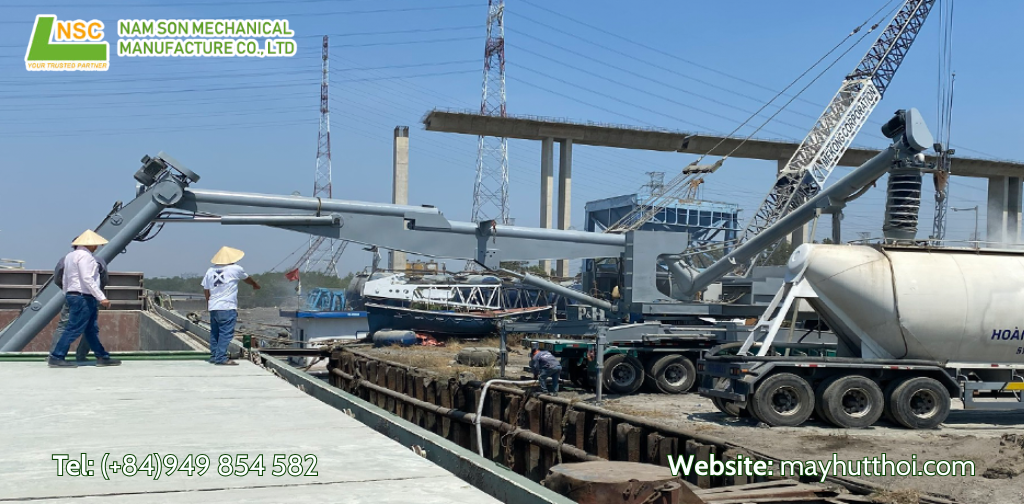
After successful mixing, the air–cement suspension enters the cement unloading pipeline system, where the primary transport phase takes place. Within the pipeline, the working principle remains consistent: kinetic energy from the airflow is transferred to the cement particles through drag forces. These forces counteract gravity and friction against the pipe walls, enabling material to travel over long distances. In pneumatic conveying cement from ship, pipeline geometry, internal surface condition, and directional changes all influence pressure drop and flow behavior. However, the fundamental mechanism does not change. Cement particles continue to move as long as sufficient airflow and pressure differential are maintained along the conveying route.
Pneumatic Cement Ship Unloader Working Principle During Ship-to-Shore Conveying
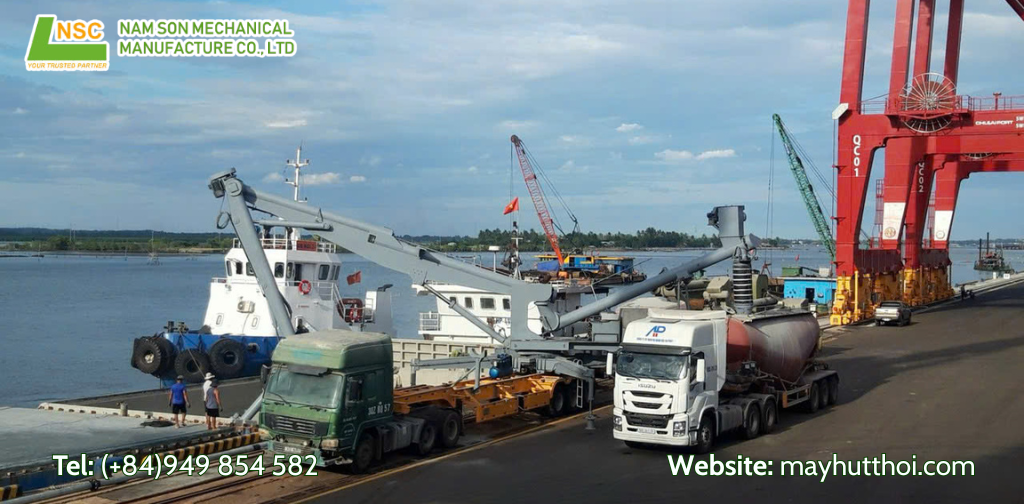
In the context of ship to shore cement unloading systems, the pneumatic conveying principle must remain stable across extended conveying distances. As the air–cement mixture travels from the vessel to the shore-based receiving point, system pressure gradually decreases due to frictional and dynamic losses. To compensate for this, the pneumatic cement ship unloader is designed to maintain adequate airflow throughout the conveying line. The working principle during this phase is a balance between air supply capacity and material loading. When correctly regulated, the system ensures continuous material movement without segregation or deposition, preserving the integrity of the pneumatic conveying process from ship hold to discharge point.
Pneumatic Cement Ship Unloader Working Principle in Cement–Air Separation
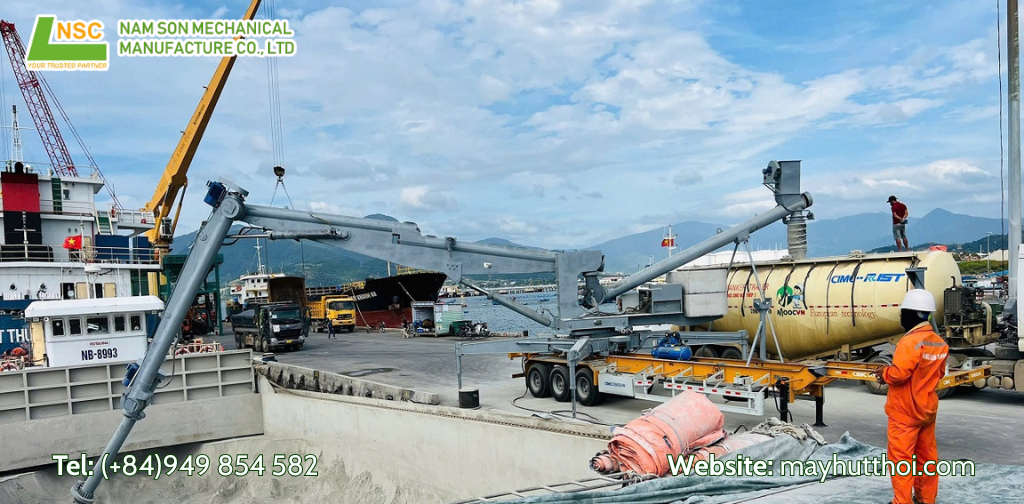
At the receiving end of the system, the pneumatic cement ship unloader working principle transitions from conveying to separation. The air–cement mixture enters a separation unit where cement particles are removed from the airflow. This process relies on differences in mass and inertia between air and solid particles. Devices such as cyclones or filtration units cause cement to lose momentum and fall out of suspension, while the conveying air continues through the system. This stage enables cement unloading from ship to silo by directing separated cement into storage while preventing material from escaping with the exhaust air. The separation mechanism completes the pneumatic conveying cycle and reinforces the closed-loop nature of the unloading process.
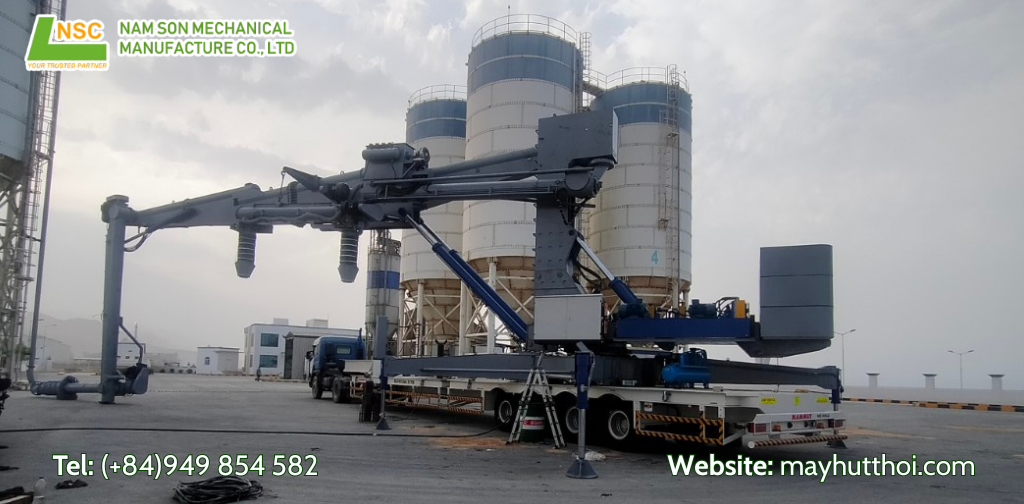
Pneumatic Cement Ship Unloader Working Principle Under Vacuum and Pressure Systems
Although the fundamental conveying mechanism remains unchanged, the pneumatic cement ship unloader working principle can be implemented using different pressure generation methods. In a vacuum pneumatic cement unloader, airflow is induced by creating negative pressure at the receiving end, causing air and cement to be drawn toward the separator. In contrast, a pressure pneumatic cement unloader operates by supplying compressed air at the material pickup point, pushing the air–cement mixture through the pipeline. Some systems combine both approaches in a combined vacuum pressure unloader, where material is initially extracted under vacuum and subsequently conveyed under positive pressure. These variations alter the pressure profile of the system but do not modify the underlying pneumatic conveying principle.
Pneumatic Cement Ship Unloader Working Principle in Different Conveying Modes
The working principle of a pneumatic cement ship unloader is also influenced by the selected conveying mode within the pneumatic system. In dilute phase pneumatic cement conveying, cement particles are fully suspended in high-velocity air, resulting in a relatively uniform flow pattern. Conversely, dense phase pneumatic conveying cement operates at lower air velocities and higher material concentrations, where cement moves in compact formations or plugs. Despite these differences, both modes rely on the same core mechanism: the transfer of energy from airflow to solid particles to achieve controlled movement. The choice of conveying mode affects system behavior but does not alter the fundamental working principle.
.png)
Pneumatic Cement Ship Unloader Working Principle Summary
In summary, the pneumatic cement ship unloader working principle in pneumatic conveying systems is defined by a continuous sequence of airflow-driven processes. Cement is extracted from the ship hold through pressure differentials, mixed with air to form a transportable suspension, conveyed through pipelines using aerodynamic forces, and finally separated from the air stream at the receiving point. All system variations, including vacuum or pressure operation and different conveying modes, are implementations of the same pneumatic conveying logic. This unified working principle explains how pneumatic cement ship unloaders achieve controlled, enclosed, and continuous cement transfer using airflow as the sole means of material transport.
Contact us
If you require technical details or a customized solution related to pneumatic cement ship unloaders, please contact our engineering team for professional consultation and system configuration support.
✱ Website: mayhutthoi.com|
namsonco.com✱ Alibaba: dthson.trustpass.alibaba.com✱ Facebook: facebook.com/NamSonPneumaticConveyor✱ Zalo/Whatsapp:(+84) 949854582
✱ Email: mailan@namsonco.com | thanhson@namsonco.com


